
What drives the largest cost driver in peacekeeping?
Troop reimbursement and the pass-through problem
Reimbursement to troop- and police-contributing countries for their military and police personnel is the single largest expense in UN peacekeeping operations, and costs member states well over one billion dollars each year.1 The General Assembly has an opportunity to review the reimbursement rates later this year, and it should seize the moment to address an underlying issue that has driven the artificial inflation of reimbursement rates since the current reimbursement methodology was adopted in 2013. Doing so would not only increase the level of troops and police that can be deployed under existing financial constraints, but would also help address persistent performance issues by addressing an underlying mismatch in incentives for participation in UN peace operations.
The current personnel reimbursement methodology
The UN has provided reimbursement to troop- and police-contributing countries (T/PCCs) at standardized rates to help defray the costs of their deployment beginning in 1973. From the very beginning, the determination of an appropriate rate of reimbursement was complicated by the fact that many T/PCCs refused to provide data on the actual costs incurred.2 As a result, reimbursement rates—and the period increases in successive decades—were largely arbitrary. This was the source of persistent tension between major T/PCCs and major financial contributors; the former wanted increases in the rate to account for increasing costs while the latter refused to pay unless T/PCCs provided evidence for those costs.
To break the impasse, the General Assembly asked the Secretary-General to establish a senior advisory group on rates of reimbursement and other related issues. The 2012 report of the senior advisory group recommended a new approach on the basis of a survey of a representative sample of 10 of the top 20 T/PCCs,3 to be conducted every four years. The survey would collect “the common and essential additional costs incurred by contributing countries in deploying their forces to United Nations peacekeeping missions” in the following five categories:
Allowances
Clothing, gear and equipment
Pre-deployment medical expenses (e.g., vaccinations)
Inland travel (i.e., the costs of moving T/PCCs to the port of embarkation)
Delivery of United Nations-mandated training
The General Assembly approved the recommendations in 2013, and four rounds of surveys have since been completed: in 2014, 2018, 2022, and 2026. On the basis of the 2022 survey results, the General Assembly approved the current reimbursement rate of $1,448 per person per month.
The pass-through problem
The results of the most recent survey are as follows:
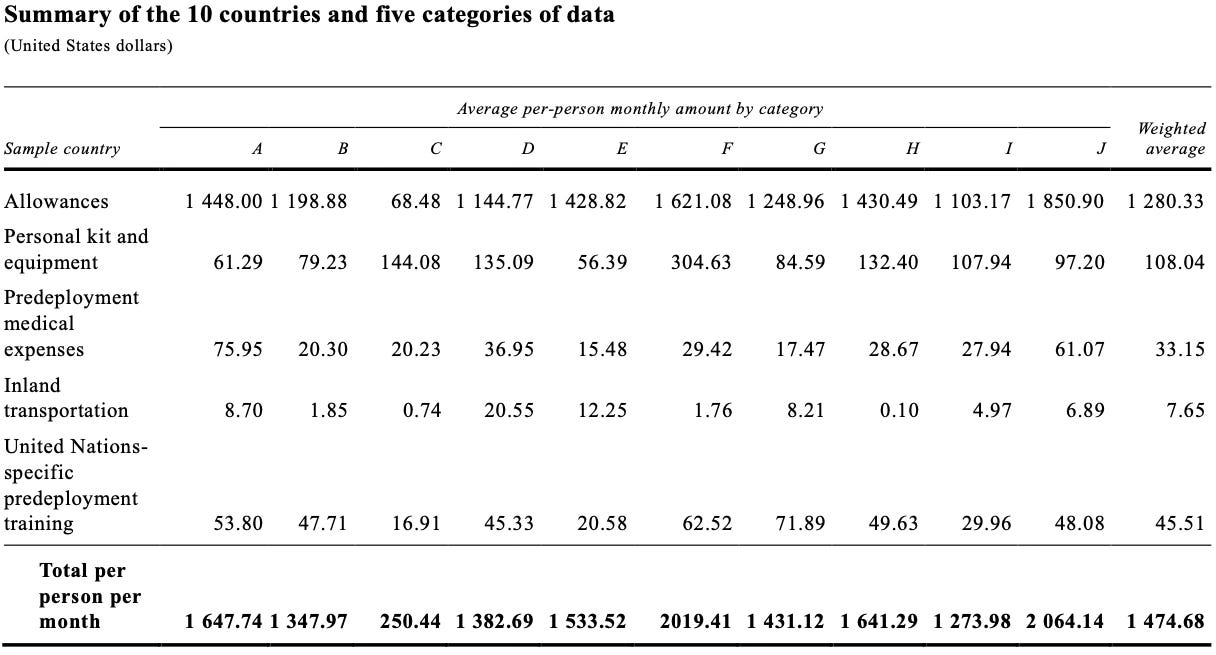
Allowances are by far the largest costs reported by the 10 T/PCCs, accounting for 86.8% of the weighted average costs. It’s important to underline that the allowances reportable in the survey are not salaries—which remain national responsibilities—or any regular allowances payable when troops are not deployed abroad. The types of allowances the senior advisory group had in mind include the hazard, hardship, and family separation allowances that are paid by many militaries for overseas service.
Each time the survey has been conducted, the Secretary-General has noted that there is considerable variation in the types of allowances paid, but it consistently finds that many T/PCCs include a flat rate allowance linked to the current reimbursement rate. In other words, some percentage of the UN reimbursement is provided directly to individual troops.4 The Secretariat has described this portion of the allowances as a “pass-through” payment.5
The UN reimbursement rate is intended to cover the costs incurred by T/PCCs that they would not otherwise incur if their troops and police were not deployed to a UN peace operation. But by their very nature, pass-through payments are not costs incurred by T/PCCs. The inclusion of such payments in the cost survey is therefore incompatible with the methodology approved by the General Assembly. It also serves to obscure the extent to which reimbursement rates far exceed the actual additional costs incurred by most T/PCCs in deploying to peace operations.
Moreover, when pass-through costs are included, they create a strong inflationary effect in the reported cost data, that will drive the reimbursement rate upwards even if costs do not increase. Imagine, for example, that there is only one sample T/PCC, and it provides half of the reimbursement paid as a pass-through payment to its troops and police. Even if all of its costs remain the same, the inclusion of the pass-through payment as part of the allowances would lead to increases in each subsequent survey. This effect is illustrated, in simplified terms, in the chart below.
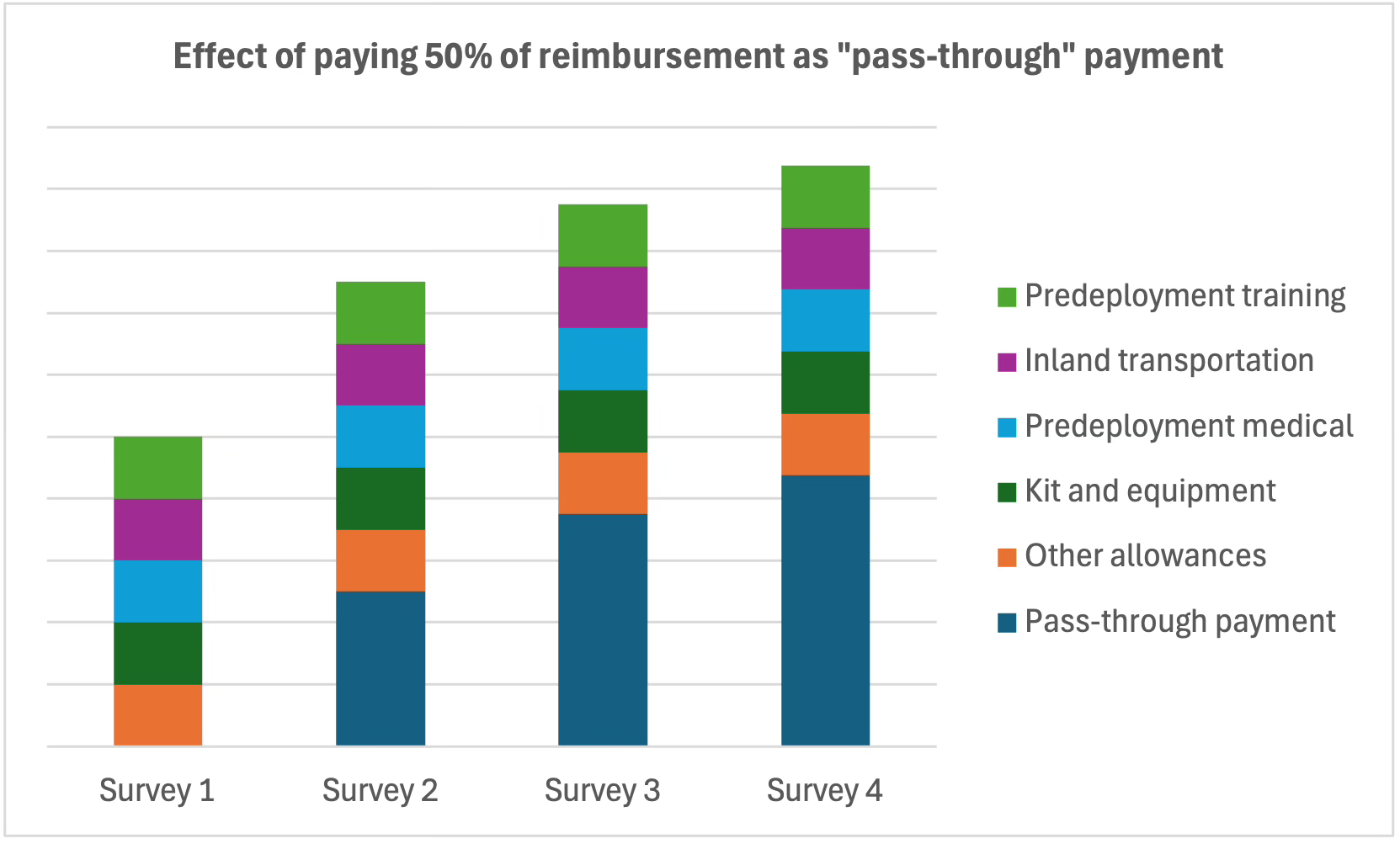
For both legal and methodological reasons, pass-through payments should not be included in the survey data and should not be taken into consideration by the General Assembly in determining the reimbursement rate.
The link between reimbursement and contribution
In their seminal work on peacekeeping contributions, Alex Bellamy and Paul Williams identified political, economic, security, institutional, and normative rationales that may motivate individual member states to contribute personnel to peace operations.6 Since then, other studies have built on those findings to identify not only the reasons why T/PCCs participate, but the effect of that participation.7 These studies show that the financial incentives provided by reimbursements are a major motivating factor for why many T/PCCs participate in peace operations.8 In many major T/PCCs, UN reimbursements represent a larger share of military revenue than the proportion of troops deployed to peace operations,9 often by a dramatic amount.10
But there are many other reasons why T/PCCs participate in peace operations. Not only does participation allow T/PCCs to provide a tangible contribution to the maintenance of peace and security, but it also provides a range of benefits. Deployment provides troops and police valuable training and field experience,11 as well as the opportunity to work alongside and learn from other militaries. It can also allow T/PCCs—particularly those with weak legitimacy—to garner and retain prestige from major powers.12 Deployment of troops abroad as part of peace operations is also an effective way for some T/PCCs to reduce the risks of coups.13 And even outside of UN reimbursements, T/PCCs can gain economic benefits given the willingness of major donors to use foreign aid to incentivize deployment to missions14 or to provide bilateral security assistance, including training and equipment.15
To exclude pass-through payments from the survey would undoubtedly yield a weighted average that is below the current level of reimbursement paid. But a reduction in the reimbursement rate would still more than cover the additional expenses incurred by the majority of T/PCCs. It would also allow more troops and police to be deployed. Since October, the UN has had to repatriate 25 percent of uniformed personnel deployed to peacekeeping operations to address financial shortfalls driven primarily by the failure of the United States to meet its financial obligations. A lower rate of reimbursement would allow more T/PCCs to benefit from participation in peace operations while also allowing missions to more effectively implement their mandates.
Final thoughts
Ultimately, the purpose of reimbursement should not be to provide T/PCCs with a major source of additional revenue, but to overcome any disincentive created by the costs of deployment.
But the senior advisory group did not only recommend a new methodology for determining the rates of reimbursement. It also introduced a risk premium payable to units operating without restrictions and caveats that have acquitted themselves well despite exceptional levels of risk and a premium for key enabling capabilities that are in high demand and short supply. In recent years, these premiums have not been requested by individual missions even when the payment of risk premiums would have been justified or when enabling premiums could have helped incentivize the deployment of specialized capabilities. Beyond pushing to exclude pass-through payments from the survey results, member states should press the Secretariat for the reasons why the risk and enabling premiums are not being paid and to see whether these tools can be more effectively utilized.
More broadly, member states should take advantage of the fact that this will be the first time that all elements of the current framework for the engagement of military and police personnel—including memorandums of understanding, personnel reimbursement, and contingent-owned equipment—will be considered at the same time by the Fifth Committee. The existing framework is not effective in generating the capabilities required in peace operations, incentivizing the posture and actions needed on the part of military and police contingents, or ensuring accountability for the performance of individual units. The General Assembly should use this opportunity to review the functioning of the overall framework and launch a process to modernize the framework to better enable the type of peace operations required to meet contemporary and emerging threats to international peace and security.
© 2026 Eugene Chen under CC BY-NC-ND 4.0
The views expressed herein are those of the author and do not necessarily reflect the views of the United Nations University.
And this doesn’t even include reimbursement to troop- and police-contributing countries for contingent-owned equipment, which is the second largest cost driver in peacekeeping operations.
Bennett, W. T. Jr. (1974, July 12). Reimbursement formula for UNEF/UNDOF troop contributors [Diplomatic cable]. U.S. Department of State. https://wikileaks.org/plusd/cables/1974USUNN02426_b.html
Under the methodology approved in resolution 67/261, the sample must include T/PCCs from across all four World Bank income categories, with the representation of each category within the sample proportionate to the representation of each category among all military and police personnel deployed over the previous three years.
Some T/PCCs provide the entirety of the standard reimbursement rate to their troops (as in the case of sample country A in the 2026 survey), while several other T/PCCs provide a percentage to troops (often on a sliding scale based on rank) and treat the remainder as revenue for their general defense budget.
United Nations (2014). Results of the revised survey to establish the standard rate of reimbursement to troop-contributing countries, as approved by the General Assembly in its resolution 67/261 on the report of the Senior Advisory Group on rates of reimbursement to troop-contributing countries: Report of the Secretary-General, 11. https://undocs.org/en/A/68/813
Bellamy, A. J., & Williams, P. D. (Eds.). (2013). Providing peacekeepers: The politics, challenges, and future of United Nations peacekeeping contributions (1st ed). Oxford University Press.
Wilén, N., & Williams, P. D. (2024). Peacekeeping armies: How the politics of peace operations shape military organizations. International Affairs, 100(3), 919–939. https://doi.org/10.1093/ia/iiae059
Gaibulloev, K., George, J., Sandler, T., & Shimizu, H. (2015). Personnel contributions to UN and non-UN peacekeeping missions. Journal of Peace Research, 52(6), 727–742. https://doi.org/10.1177/0022343315579245
Sakib, N., & Rahman, M. M. (2023). The Political Economy of Peacekeeping: Civil–Military Resource Substitution through International Brokerage. Foreign Policy Analysis, 19(3), orad014. https://doi.org/10.1093/fpa/orad014
Coleman, K. P., & Nyblade, B. (2018). Peacekeeping for profit? The scope and limits of ‘mercenary’ UN peacekeeping. Journal of Peace Research, 55(6), 726–741. https://doi.org/10.1177/0022343318775784
Tchie, A. E. Y. (2023). Beyond the Battlefield: The Impact of United Nations and African-Led Peacekeeping on Enhancing Capabilities of African Armies. Journal of International Peacekeeping, 26(4), 368–393. https://doi.org/10.1163/18754112-26040006
Victor, J. (2010). African peacekeeping in Africa: Warlord politics, defense economics, and state legitimacy. Journal of Peace Research, 47(2), 217–229. https://doi.org/10.1177/0022343309354142
Lundgren, M. (2018). Backdoor peacekeeping. Journal of Peace Research, 55(4), 508–523. https://doi.org/10.1177/0022343317747668
Boutton, A., & D’Orazio, V. (2020). Buying blue helmets: The role of foreign aid in the construction of UN peacekeeping missions. Journal of Peace Research, 57(2), 312–328. https://doi.org/10.1177/0022343319865929
Emmanuel, N. (2015). African peacekeepers in Africa: The role of United States assistance and training. African Security Review, 24(1), 23–38. https://doi.org/10.1080/10246029.2014.993668